 LinkedIn







Formulas for Silver Nutrition: the key role of dairy proteins in healthy aging
According to projections, the proportion of people worldwide over the age of 60 will rise from 12% in 2015 to 22% in 2050, almost doubling in 35 years. For manufacturers, the challenge is clear: to support health, independence, and quality of life by offering products with high nutritional value that take both dietary habits and eating pleasure into consideration. Silver nutrition is therefore emerging as a key strategic area for development and innovation. In this rapidly growing market segment, dairy ingredients have a key role to play, as their nutritional qualities are perfectly suited to the diverse and very specific needs of older people.
Silver Nutrition: what are we talking about?
A trend that fits in with the healthy aging movement
According to a study conducted by Toluna Harris Interactive,[1] 76% of respondents believe that a person who “ages well” is above all physically fit for their age, and without pain or joint problems. This perception is in line with the underlying trend of healthy aging, which aims to prolong healthy life expectancy through a holistic approach combining regular physical activity, a balanced diet, maintaining social ties, attention to mental and cognitive health, and self-care. Within this framework, Silver Nutrition aims to design nutritional products and solutions precisely tailored to the needs of older people, with nutritional and sensory profiles compatible with their uses, to support mobility, independence, and quality of life.
The Silver Economy and Silver Nutrition: Addressing the needs of older people
The Silver Economy, recognized for over twenty years, has three main objectives: to provide goods and services that improve the quality of life of older people, preserve their independence for as long as possible, and extend life expectancy.[2]
In this context, Silver Nutrition is the dietary counterpart, referring to all strategies, products, and services that adapt nutrition to the specific needs of seniors, balancing nutritional density, safety, and sensory acceptability to support health, mobility, and independence.

Which populations are we talking about?
There is no set age for “becoming” an older person. Today, biological age often differs from chronological age: the same age group encompasses very different situations. As a result, it is difficult to convey the right messages to a target audience that does not always feel concerned and may perceive itself as stigmatized.
Silver nutrition therefore covers all profiles: active older people (autonomous and independent), older people affected by frailty (who have moderate health problems with a limited impact on their daily lives), and dependent older people (who need help with essential tasks).
For manufacturers, the key is to tailor formulations and uses to each profile: understanding specific physiological needs (energy density, protein and micronutrient intake, tolerance), adapting formats and textures, and working on sensory acceptability in order to offer truly relevant products without stigmatization.
Very specific needs
With advancing age, the incidence of a broad range of diseases increases, and malnutrition exacerbates both their frequency and severity. Nutritional prevention is therefore a key lever for reducing these risks and preserving independence and quality of life.
The scourge of undernutrition
Malnutrition refers to a state of insufficient intake of energy, protein, and essential nutrients.[1] To maintain its functions, the body draws on its reserves, leading to muscle wasting (sarcopenia), reduction in adipose tissue, and weight loss. In France, nearly 800,000 older people are affected. There are many causes: loss of appetite, cognitive impairment, digestive problems, difficulty chewing or swallowing, polypharmacy, and isolation. This condition creates a breeding ground for other complications, with significant clinical and economic impacts.
Sarcopenia and muscle loss
Sarcopenia is a progressive and generalized loss of muscle mass, which significantly increases the risk of falls and fractures. The primary lever for limiting its prevalence is sufficient protein intake, in order to slow down the decline in muscle mass and function. In France, ANSES recommends 1.0 g of protein/kg of body weight/day for older people (compared to ~0.8 g/kg for adults), with intakes of up to 1.5 g/kg/day in the most serious cases. It is essential to choose highly digestible proteins and to spread intake evenly throughout the day.

Osteoporosis and bone health
Bone mass naturally decreases with age, a phenomenon that is significantly more common in women (2-3 times more than in men)[1] due to menopause, as it disrupts bone remodeling by lowering estrogen and androgen levels. To maintain bone health, two nutritional factors are essential: sufficient calcium and protein intake. At the heart of Silver Nutrition, dairy proteins stand out for their high biological value and complementarity, making them particularly relevant ingredients for formulas dedicated to “aging well.”
Milk proteins fit perfectly into Silver Nutrition products.
Fortified products
Enriching everyday products (dairy desserts, cereal bars, cookies, cheeses) with calories and protein is an effective strategy for improving the nutritional intake of the Silver generation. For manufacturers, the challenge is to ensure nutritional performance while maintaining a familiar and enjoyable sensory experience. Lactalis Ingredients’ expertise and solutions make this development more accessible from a technical and sensory standpoint.
In this regard, Laktein WPC 80, a whey protein concentrate, offers a high protein content and an amino acid profile that is particularly suited to functional applications. Its neutral taste makes it easy to incorporate into matrices that are popular with older people, limiting the impact on the flavor profile of the finished product.
Oral nutritional supplements
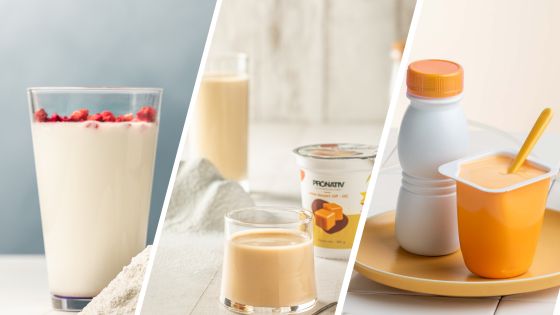
Between 2019 and 2023, the number of people covered by French national health insurance who received at least one prescription for oral nutritional supplements (ONS) increased by approximately 15%.[3] This trend confirms the growing role of ONS in preventing malnutrition among vulnerable populations. Formulated to be rich in energy, protein, vitamins, and minerals, they help ensure adequate nutritional intake when regular food is no longer sufficient.
Studies conducted in Ireland also indicate that the most commonly consumed ONS are high-calorie drinks, highlighting the value of ingredients optimized for liquid matrices.[5]
In view of these emerging trends, Pronativ® – Native Micellar Casein is particularly suitable, characterized by high BCAA content, slow digestion kinetics ensuring prolonged release of amino acids, and providing an essential source of calcium intake. These characteristics are particularly useful during periods of fasting, as they slow down the breakdown of muscle mass, making it an effective tool for supporting muscle mass and bone health in the silver demographic. In addition, its neutral taste ensures the acceptability of the finished product.
For its part, Pronativ® 95 is a pure and natural native whey protein with high protein content, rich in leucine and BCAAs, designed to support protein synthesis and muscle function in older people.
Conclusion
Silver nutrition opens up a wide range of opportunities for manufacturers and is fully in line with the growing trend towards healthy aging. Now is the right time for manufacturers to gain a foothold in this emerging market through differentiated offerings, with the essential condition that the needs and expectations of the target audience are clearly identified. With this in mind, Lactalis Ingredients is the ideal formulation partner, providing high-performance protein solutions and technical support to develop enriched products that are effective and appreciated by the Silver demographic.
A question ? Contact-us !
Sources:
[1] Survey conducted on May 28, 2023 among 1,037 people representative of the French population aged 18 and over for the Nutriform Business Days conference
[2] https://www.economie.gouv.fr/entreprises/innover-et-numeriser-son-entreprise/quest-ce-que-la-silver-economie-ou-economie-des
[3] https://www.ameli.fr/assure/sante/themes/amaigrissement-et-denutrition/comprendre-la-denutrition
[4] https://www.anses.fr/fr/content/les-proteines
[5] https://www.ameli.fr/gironde/assure/sante/themes/osteoporose/comprendre-osteoporose
[6] Geraghty AA, McBean L, Browne S, Dominguez Castro P, Reynolds CME, Hanlon D, Bury G, O’Neill M, Clarke S, Clyne B, Finnigan K, McCullagh L, Kennelly S, Corish CA. Disparities in Oral Nutritional Supplement Usage and Dispensing Patterns across Primary Care in Ireland: ONSPres Project. Nutrients. 2022 Jan 14;14(2):338.