 LinkedIn












Casein: The Key Ingredient for Protein Bars That Stay Soft
In an expanding high-protein bar market, texture has become a key differentiation criterion. To meet consumer expectations for sensory quality, Lactalis Ingredients examines the mechanisms of bar hardening through a dedicated webinar, exploring solutions for preserving soft and stable texture over time.
A Booming High-Protein Bar Market
The global protein bar market, estimated at $5.6 billion in 2025, is expected to grow by 6% annually until 2030 [1]. While North America and Europe remain the primary markets, the strongest growth opportunities are located in Asia, the Middle East, and Oceania. This growth is fueled by rising demand for convenient, nutrient dense solutions that support active lifestyles.
Key Market Trends
The protein bar market development is supported by several strong trends:
- Growing demand for convenience: Consumers increasingly favor ready-to-consume breakfast and snacking solutions. High-protein bars meet this need through their portable format and easy daily integration. [2]
- Rise of sports nutrition: The democratization of sports practice and growing interest in high-protein diets are driving demand for products that combine nutritional performance with convenience. [3]
- Emergence of GLP-1 treatments: Growing adoption of GLP-1 treatments increases demand for nutrient-dense foods that deliver high protein in smaller portions. High-protein bars offer an ideal solution to increase protein intake in reduced portions. [4]
Texture: A Key Consumer Criterion
While protein content remains a decisive purchase driver, texture is also a major lever for accepting protein bars. Consumers prefer soft and melt-in-the-mouth textures that evoke pleasure and freshness. Yet preserving these characteristics throughout shelf life remain a critical challenge for manufacturers. [5]
Why Do High-Protein Bars Harden During Storage?
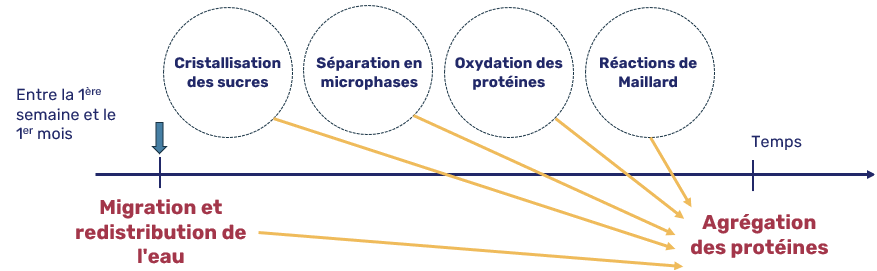
High-protein bars are complex systems composed of proteins, syrups, fats, and water. Although they appear relatively dry, their components continue to interact after manufacturing, leading to texture changes during storage.
During storage, two main mechanisms contribute to hardening:
Water Migration
Water gradually redistributes throughout the bar’s matrix, particularly between the syrup phase and protein components. This migration alters the product’s balance and promotes structural changes, contributing to a progressive increase in firmness.
Protein Aggregation
Over time, proteins develop stronger interactions with each other. This creates a denser protein network that progressively stiffens the bar structure and reduces its flexibility.
Other phenomena, such as sugar crystallization, Maillard reactions, or protein oxidation, can also intensify hardening and compromise sensory quality during shelf life.
Protein Selection: A Major TextureDriver
Not all proteins influence the texture of protein bars in the same way. Some provide structure and facilitate industrial processing but may also promote hardening during storage—notably many dairy and plant-based protein concentrates.
Conversely, others help maintain a softer texture. Casein stands out for its specific behavior: it delivers proteins while limiting excessive matrix structuring.
Why Is Casein Particularly Interesting in High-Protein Bars?
Unlike many proteins used in bars, casein is presented as pre-aggregated particles. This specific structure gives it low water affinity and limits protein interactions within the matrix, thus helping to preserve a softer texture during storage.
This characteristic provides several advantages:
- Limitation of water migration phenomena;
- Reduction in the formation of protein networks responsible for hardening;
- Better texture stability during storage;
- Natural dairy flavor;
- Reduced browning from Maillard reactions.
Studies conducted by Lactalis Ingredients show that formulations incorporating casein maintain a softer texture and harden less during storage than those made with other protein sources such as caseinates. They also deliver high protein content while preserving good sensory quality.
Designing Rich, Soft, and Stable High-Protein Bars
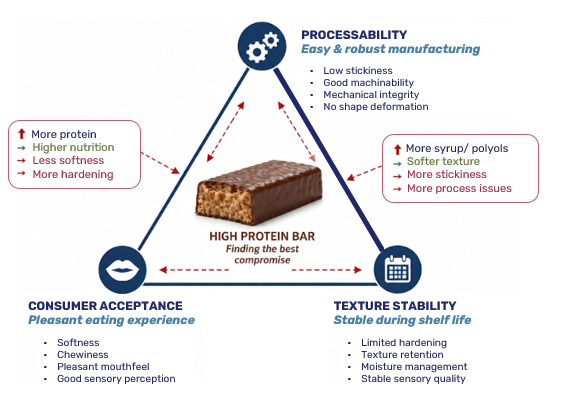
The formulation of a high-performing high-protein bar depends on balancing protein content, sensory quality, and texture stability. Combined with more structuring proteins, casein provides an effective solution for developing protein-rich bars while preserving their softness and stability during storage.
Explore New Opportunities Through Casein
Mastering texture is a key challenge in high-protein bar development. Understanding hardening mechanisms and the role of different proteins allow you to optimize formulations to guarantee pleasant texture throughout shelf life. To address these challenges, Lactalis Ingredients offers a range of acid and rennet caseins specially adapted for sports nutrition and high-protein bar applications.
To discover in detail the mechanisms of bar hardening and the unique benefits of casein for maintaining soft and stable texture, watch our webinar replay and contact our experts.
A question ? Contact-us !
Sources:
[1] Estimations basées sur GlobalData (2025); Fortune Business Insights (2026); Market Reports World (2026).
[2] On-the-Go Breakfast Product Market. Fortune Business Insights, 2026.
[3] Protein Bar Market. Business Research Insights, 2026.
[4] Snack, Nutrition and Performance Bars – US. Mintel, 2026.
[5] Mintel, 2026; Nutrition Insights, 2026