 LinkedIn















Endurance athletes: how much protein do you need for optimal performance?
Marathons, trail running, triathlons and long-distance cycling: endurance sports – that is, any activity lasting more than 30 minutes at moderate to high intensity – place demands on the body that go well beyond its carbohydrate reserves. During these activities, protein plays a fundamental role in muscle fibre repair, training adaptation, and recovery.[1] In this article, we will explore the specific nutritional needs, optimal times for consumption, and the most popular forms among endurance athletes.
Specific protein needs: why endurance is no exception to the rule
Why does endurance training increase protein requirements?
Contrary to the common misconception that links protein to weight training, endurance sports also generate high protein requirements. Prolonged exercise (beyond 90 minutes) causes cumulative muscle damage that requires fibre repair, pushing protein needs well above those of a sedentary population.[2] Protein also plays a role in enzyme synthesis and in adaptation to training (the process of improving aerobic capacity, mitochondrial density, and metabolic efficiency, which determines an athlete’s progress).[3]
Nutritional guidelines for endurance athletes
The EFSA recommends a daily protein intake of 0.83 g per kilogram of body weight, which is insufficient for endurance athletes.[2] ANSES estimates these requirements to be between 1.2 and 1.6 g/kg/day, depending on training load, or 84 to 112 g per day for a 70-kg athlete.[3] One scientific study even suggests an optimal intake of about 1.8 g/kg/day during periods of intense training.[4]
Beyond quantity, two qualitative factors determine the effectiveness of these intakes. First, the quality of the proteins: those rich in essential amino acids and leucine are the most effective at stimulating muscle protein synthesis.[1] Next, the distribution: four doses spaced 3 to 4 hours apart throughout the day significantly optimise protein synthesis compared to a single large dose.[1] So how do you choose which protein to eat based on the time of day?
Before, during, and after exercise: the right timing for protein intake
Before exercise
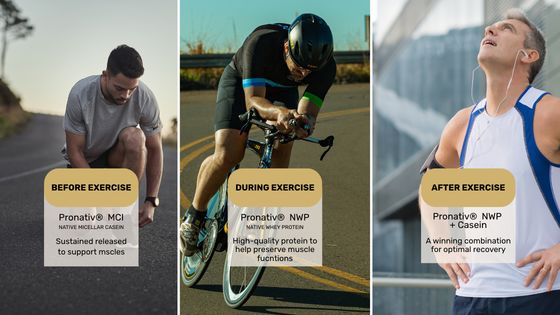
Slow-digesting proteins (caseins) help prevent the muscle breakdown that typically occurs during exercise. Their gradual release helps maintain a favourable nitrogen balance.[1]
Fast-digesting proteins, such as whey, stimulate muscle anabolism. When taken together before exercise, these two proteins work together to initiate muscle synthesis (whey) and limit catabolism (casein).
During exercise
For workouts lasting less than 90 minutes, protein is not necessary: carbohydrates and hydration remain the top priorities.[1] For events lasting longer than 90 minutes (trail running, ultra-marathons and long-distance triathlons), however, combining carbohydrates and protein helps limit muscle damage and preserve glycogen stores. BCAAs (branched-chain amino acids: leucine, isoleucine, valine) reduce central fatigue (a neurological phenomenon linked to the accumulation of tryptophan in the brain, which impairs motivation and the perception of exertion) during extreme endurance events.[1]
After exercise
The anabolic window – the period between 0 and 90 minutes after the end of exercise – is the optimal time for protein intake: the muscle is particularly receptive to amino acids during this time.[1] Fast-digesting proteins, such as whey, stimulate post-exercise protein synthesis to a greater extent.[5] In addition, consuming 30 to 40 g of casein before bedtime increases night-time protein synthesis without disrupting lipolysis, which is particularly beneficial during periods of intense training.[1]
Lactalis Ingredients dairy ingredients designed for endurance
Formats designed to meet the demands of endurance sports and athletes’ expectations
Beyond nutritional composition, the product’s format is a key factor in adherence among endurance athletes and a demanding formulation criterion for contract manufacturers.
During exercise, liquid or semi-liquid formats – which are easy to consume while on the move – are ideal: energy gels and drinks, sometimes enriched with BCAAs to limit muscle breakdown and central fatigue during long workouts.[6]
After exercise, instant powders dominate the market thanks to their versatility, flexible dosing, and rapid dissolution. Protein bars and snacks – which are harder to consume during exercise – have established themselves as on-the-go options for nutrition and recovery, with an impressive 39% increase in new product launches per year.[6] The same is true of RTD (Ready-to-Drink) protein drinks, which are experiencing strong growth thanks to their convenience,[6] for consumption before or after exercise.
Two cross-cutting requirements also shape this market: the “clean label” approach (approximately 44% of athletes prefer clean-label products[6]), and digestibility (during intense exercise, blood flow is redirected to the working muscles at the expense of the digestive system, which could reduce nutrient absorption[6]).
To meet these requirements for form and digestibility, Lactalis Ingredients offers dairy proteins tailored to the specific times of consumption for endurance athletes.
Lactalis Ingredients: a range of dairy proteins tailored to every occasion
Pronativ® MCI, native micellar casein
A slow-digesting protein that ensures a sustained release of amino acids, making it ideal before exercise and at bedtime for overnight recovery. Extracted through cold filtration, without additives or chemical treatment, this is a native protein with minimal denaturation that aligns with a clean-label approach. Its high micellar casein content (90% micellar casein compared, to 80% of the protein in whole milk), low viscosity, and neutral taste make it suitable for beverages and high-protein formulas. It is also a source of calcium, a key benefit for endurance athletes subjected to repetitive stress on their bones.[7]
Acid Casein 110 Mesh
Thanks to its fine particle size, it delivers a smooth, grain-free texture, even without a dissolution step. This is a decisive industrial advantage for formulators. Its neutral flavour and high protein content make it an ingredient of choice for protein-enriched bars. It is also suitable for labelling as “reduced-lactose” or “lactose-free.”
Rennet-treated Casein for high-protein bars
It offers a soft, less brittle texture that remains stable without hardening during storage, a common challenge with high-protein bars. It also has a neutral taste that avoids the astringent or sulphurous notes sometimes associated with other proteins. It is currently the most cost-effective option among dairy proteins for bars, serving as an effective replacement for caseinates.
Pronativ® NWP, native whey protein
Extracted directly from milk via cold filtration, without additives or chemical treatment, this native whey protein is naturally rich in leucine and is rapidly digested. It is particularly well suited for recovery, to kick-start protein synthesis immediately after exercise. It can also be used during exercise, particularly in gels – a standard format not covered by caseins.
Conclusion
For endurance athletes, protein is not an optional supplement – it is a cornerstone of performance and recovery. Mastering intake levels, timing of consumption, and dosage forms makes the difference between passive recovery and controlled progress. Pronativ® embodies this nutritional precision, offering scientifically grounded solutions.
As we have seen, each format has its own technical constraints and requirements in terms of digestibility and quality. Our experts will guide you in selecting the dairy ingredients best suited to your market and your formulation goals.
A question ? Contact our team!
Sources:
[1] Jäger R. et al., ISSN Position Stand: Protein and Exercise, Journal of the International Society of Sports Nutrition 2017 https://www.ncbi.nlm.nih.gov/pmc/articles/PMC5477153/
[2] EFSA Panel on NDA, Scientific Opinion on Dietary Reference Values for protein, 2012, https://efsa.onlinelibrary.wiley.com/doi/10.2903/j.efsa.2012.2557
[3] ANSES, Avis relatif aux compléments alimentaires destinés aux sportifs, 2016 https://www.anses.fr/fr/system/files/NUT2014SA0008Ra.pdf
[4] Kato H. et al., Protein Requirements Are Elevated in Endurance Athletes after Exercise, 2016 https://www.ncbi.nlm.nih.gov/pmc/articles/PMC4913918/
[5] R. Jager, International Society of Sports Nutrition Position Stand: protein and exercise, 2017
[6] E.P de Oliveira, Gastrointestinal complaints during exercise: prevalence, etiology, and nutritional recommendations, 2014
[7] Ferreira S.V. et al., Effects of endurance exercise and dietary protein intake on osteokine, bone turnover, and inflammatory markers in endurance runners: A narrative review, Bone Reports, juin 2025.
https://doaj.org/article/a26fcad8bcfd4aa7a13a6b9324890d6f