 LinkedIn










Formulating Indulgent Lactose-Free Ice Cream with Lactose-Free Milk Powders and Low-Lactose Ingredients
The global lactose-free dairy market reached USD 13.87 billion in 2025 and is projected to hit USD 20.78 billion by 2030 — a CAGR of 8.4 % [1]. Within this category, ice creams and desserts already represent 20 % of new lactose-free dairy launches, second only to drinking dairy [2]. Yet the lactose-free claim alone no longer secures repeat purchase. What drives loyalty is sensory parity with conventional ice cream: scoopable but firm, sweet but balanced, creamy without leaning to “diet”. That requires manufacturers to confront what lactose hydrolysis actually does to the formulation — and how lactose-free skim milk powder (SMP) helps rebuild what the claim removes.
From medical niche to premium dairy platform
Lactose-free dairy started as a tolerance product. Around 68 % of the global adult population shows reduced lactase activity after early childhood, with prevalence ranging from roughly 28 % across Western, Southern and Northern Europe to over 70 % in the Middle East and parts of Asia [2]. The European consumer base has shifted: lactose-free is now bought by people who are not clinically intolerant. They associate it with lighter dairy, easier digestion and cleaner formulation logic.
Consumer with diagnosed intolerance accepts compromise. A consumer choosing lactose-free for general well-being does not. Five expectations now converge on the category:
- Digestive comfort, still the entry-level reason.
- Full dairy indulgence, not a diluted version.
- Sugar awareness, particularly in markets with HFSS (High in Fat, Sugar, and Salt) or Nutri-Score pressure.
- Ingredient simplicity, recognisable dairy names on the label.
- Premium quality cues, justifying a price step up.
Ice cream is the format where these collide most visibly. Frozen desserts are tested on pleasure first.
What lactose hydrolysis actually changes — and what the consumer actually tastes
Most lactose-free dairy systems use β-galactosidase to hydrolyse lactose into its two monosaccharides, glucose and galactose. The cascade of consequences is well documented and predictable.
Sweetness rises significantly
Lactose has a relative sweetness around 16–20 (sucrose = 100). Glucose sits around 74 and galactose around 32 [3].
When hydrolysis is complete, the dairy base becomes meaningfully sweeter at constant solids. Lactalis Ingredients reports this allows up to 25 % sucrose reduction in ice cream while maintaining acceptable perceived sweetness [4].
In the published Skryplonek work on lactose-free frozen yogurt, the formulation used 6.5 % sucrose against the typical 10–14 % range cited for the format — a 35–55 % reduction made possible by the hydrolysis-driven sweetness contribution [5].
Freezing point drops further
Freezing point depression follows a colligative law: more dissolved molecules, lower freezing point. Splitting one lactose molecule into one glucose + one galactose roughly doubles the molar contribution. Smith and colleagues quantified this in 1983: monosaccharides depress the freezing point about twice as much as disaccharides at equal mass concentration [6]. In an ice cream mix, that means a softer, more easily scoopable product at the same serving temperature — an asset for scoopability, a risk for shape retention in retail cabinets and during distribution.
Lactose-driven sandiness disappears
Les crèmes glacées conventionnelles peuvent développer une texture granuleuse lors d’une congélation lente ou à la suite de variations de température, causée par la cristallisation du lactose [4].
L’hydrolyse du lactose élimine ce risque. Dans son étude contrôlée portant sur un yaourt glacé sans lactose, Skryplonek a observé une dureté plus faible, une texture moins collante, une viscosité plus élevée, une texture crémeuse plus lisse et une meilleure résistance à la recristallisation de la glace par rapport à un produit témoin non hydrolysé [5].
Lactose-free SMP as a structural anchor
Skim milk powder is already a workhorse in conventional ice cream. It contributes milk solids-not-fat (MSNF), dairy proteins, minerals and a recognisable dairy flavour. These functions support body, foam stability, emulsion structure and creamy mouthfeel. Replacing it with a lactose-free version preserves all of that — minus the lactose.
Lactalis Ingredients offers two relevant grades [7]:

Both are produced by enzymatic hydrolysis of skim milk before spray drying. The lactose-free grade carries the proteins and minerals you want, plus the monosaccharides you have to manage. The low-lactose grade gives more formulation flexibility when full lactose-free positioning is not the target.
Three formulation scenarios with concrete arithmetic
The same logic plays out differently across formats. Three short cases, each with its own validation set.
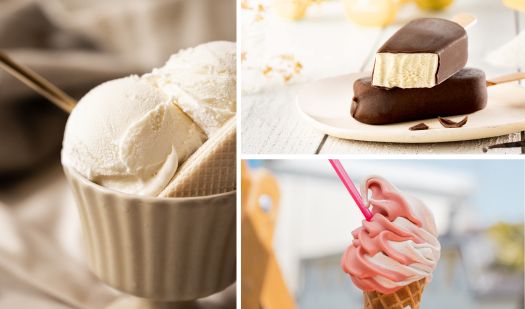
Premium vanilla tub
A typical premium vanilla mix runs at roughly 12 % MSNF, 10 % fat and 14–16 % sucrose. Switching the SMP to a lactose-free grade introduces glucose and galactose into the base. Following Lactalis Ingredients’ published 25 % sucrose reduction figure [4], sucrose can be cut to around 11–12 % to keep the sweetness profile in range.
The validation set is narrow but unforgiving:
- Scoopability at –18 °C, with cabinet shape retention over 30 days.
- Meltdown behaviour at +25 °C, monitored at 10, 20 and 30 minutes.
- Aromatic clarity of vanilla — vanilla flattens fast in over-sweet matrices.
- Texture stability over 90 days, including Maillard-driven flavour drift.
The risk to manage: over-soft scoop and shape loss in retail cabinets.
Coated lactose-free stick
The core follows the same logic as the tub. The complexity is system-wide consistency: the coating, the inclusions and any sauce must also comply with the lactose-free claim. Standard milk chocolate coatings carry lactose via milk powder or whey. A full ingredient audit is required before the claim can be asserted.
Pilot work focuses on three points:
- Coating viscosity at process temperature when dairy powders are substituted.
- Snap and gloss at consumption temperature, on a softer-than-control core.
- Resistance to in-hand meltdown, especially in warm-climate distribution.
The trap here is regulatory rather than rheological: a single non-compliant sub-component invalidates the claim across the entire SKU.
Soft-serve
Soft-serve is unforgiving because the product performs in equipment, in real time. Hydrolysed sugars push the freezing point down, which shifts draw temperature and overrun development. Skryplonek’s 6.5 % sucrose formulation against a 10–14 % reference [5] illustrates the magnitude of sucrose reduction available when monosaccharide sweetness is leveraged. In foodservice the validation has to happen on the actual machine, with the actual flavour system, at the actual ambient conditions of service. A vanilla soft-serve mix that performs at 22 °C ambient will not necessarily perform at 30 °C.
Across the three formats the principle is constant: lactose-free SMP provides the dairy structure; the formulator manages the sugar system around it.
Claim strategy: define before formulating
Claim choice changes the formulation playbook. Defining it on day one avoids costly late-stage reformulation.
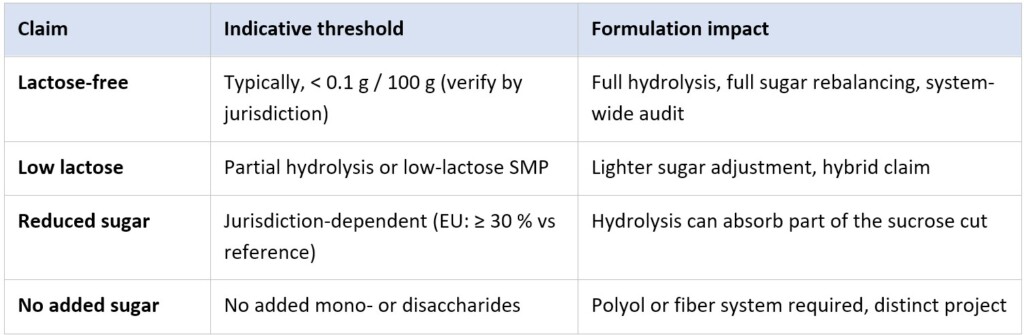
L’allégation détermine le choix des ingrédients. Le choix des ingrédients détermine le système sucrant. Le système sucrant détermine la texture.
Working with Lactalis Ingredients on ice cream development
Lactalis Ingredients sits on one side of this conversation: dairy ingredient expertise, consistent supply, and technical characterisation of how its lactose-free and low-lactose powders behave.
Where Lactalis Ingredients adds value:
- Ingredient selection guidance based on lactose target, claim, dairy solids contribution, sweetness profile, protein contribution and application format.
- Support during ingredient evaluation in the customer’s pilot trials, including troubleshooting when ingredient-related questions surface.
Where lactose-free ice cream is heading
Three pressures will shape the next three to five years.
First, sugar reduction regulation continues to tighten across Europe. UK HFSS legislation, the French and Spanish nutrient profile schemes and the wider Nutri-Score adoption all reward formulations with lower added sugar. Lactose hydrolysis is one of the few formulation levers that reduces added sugar without introducing a non-dairy ingredient — keeping the clean dairy label intact.
Second, premium dairy is being repositioned against plant-based alternatives. “Lactose-free with full dairy quality” is a sharper differentiation message than “dairy with less of the problem”. The consumer who reads the front of pack now arbitrates between digestive comfort with real dairy and digestive comfort with oat or almond bases. That is a winnable conversation for dairy, but only on demonstrated sensory quality.
The opportunity is not lactose-free at parity. It is lactose-free with measurable sensory and metabolic advantages: softer scoopability, smoother texture, suppressed sandiness, lower added sugar — supported by a claim that consumers now read as premium dairy rather than diet alternative. Brands that align claim, formulation and process upstream of development will move first.
FAQ :
1- What does lactose hydrolysis actually do to ice cream sweetness?
Lactose has a relative sweetness around 20 (sucrose = 100). Its hydrolysis products — glucose (~74) and galactose (~32) — are notably sweeter [3]. When lactose is fully hydrolysed in the dairy base, sucrose addition can typically be reduced by up to 25 % in ice cream while maintaining perceived sweetness [4].
2- Why does lactose-free ice cream feel softer?
Splitting lactose into glucose + galactose roughly doubles the molar contribution to freezing point depression [6]. At the same serving temperature, the unfrozen water fraction is higher, which translates to a softer, more scoopable product. This is an asset for scoopability and a risk for shape retention.
3- What functional role does lactose-free skim milk powder play?
It provides MSNF, dairy proteins, minerals and dairy flavour — the same structural functions as conventional SMP — while keeping lactose below 0.1 g per 100 g of powder [7]. It does not eliminate the need to rebalance the sugar system around the hydrolysed monosaccharides.
4- Can a lactose-free ice cream also be a reduced-sugar ice cream?
Often yes. The sweetness contributed by glucose and galactose lets the formulator cut added sucrose meaningfully. Whether the result qualifies for a reduced sugar claim depends on the jurisdiction’s reference product and the reduction threshold (EU: ≥ 30 % vs reference).
5- What should pilot testing focus on first?
Sweetness perception over the shelf-life window, not only at production. Scoopability at –18 °C. Meltdown at room temperature. Overrun under real equipment conditions for soft-serve.
6- Is the lactose-free claim consistent across the full product?
Only if every component complies. Coatings, inclusions and sauces frequently carry lactose via milk powder, whey or dairy fats. A full ingredient audit upstream of claim assertion is the cheapest way to avoid recall risk later.
A question ? Contact-us !
Sources:
[1] The Business Research Company. Lactose-Free Dairy Global Market Report 2026. 2026.
[2] Lactalis Ingrédients. Lactose-free desserts: innovation without compromising on enjoyment. Blog editorial, 2026. (Citant les données de prévalence mondiale de malabsorption du lactose et de part de catégorie.)
[3] Dominici S, Marescotti F, Sanmartin C, Macaluso M, Taglieri I, Venturi F, Zinnai A, Facioni MS. Lactose: Characteristics, Food and Drug-Related Applications, and Its Possible Substitutions in Meeting the Needs of People with Lactose Intolerance. Foods. 2022;11(10):1486. doi:10.3390/foods11101486. PMID: 35627056.
[4] Lactalis Ingrédients. Digestive health and lactose. Blog editorial, 2023. (Rapporte une réduction du saccharose jusqu’à 25 % dans la crème glacée via l’hydrolyse du lactose.)
[5] Skryplonek K, Gomes D, Viegas J, Pereira C, Henriques M. Lactose-free frozen yogurt: production and characteristics. Acta Scientiarum Polonorum Technologia Alimentaria. 2017;16(2):171-179. doi:10.17306/J.AFS.0478. PMID: 28703957.
[6] Smith DE, Bakshi AS, Lomauro CJ. Effects on Freezing Point of Carbohydrates Commonly Used in Frozen Desserts. Journal of Dairy Science. 1983;66(11):2464-2467.
[7] Lactalis Ingrédients. Skimmed milk powders — Lactose-free skimmed milk powder product specifications. Product page (lactose-free SMP < 0.1 g / 100 g; low-lactose SMP < 1.5 %).