 LinkedIn

















Pleasure nutrition in the Asian market
In the Asian market, nutrition is undergoing a major transformation in which two expectations are converging: preventive health and sensory pleasure. This is known as ‘pleasure nutrition’: products that combine proven nutritional benefits with an enjoyable sensory experience. Urbanisation and the rise of a discerning middle class are driving consumers towards on-the-go formats, ranging from RTD (ready-to-drink) beverages to functional snacks.
Asia: the global driving force behind pleasure nutrition
An Asian market at the heart of global innovation
In 2025, two areas of innovation dominated the Asian market: pleasure (48.3%) and health (26.4%). This convergence is no coincidence, it is rooted in a deep-seated cultural association between food and wellbeing, inherited from millennia-old traditions such as traditional Chinese medicine, Japanese functional cuisine and Ayurveda[1].
Claims such as “high in protein” or “a source of protein” now top the list of new product launches in Asia, ahead of all other regions of the world in this respect[2]. This focus on functionality has pushed the Asia-Pacific region to the forefront of the RTD drinks market, accounting for nearly half of the global functional drinks market (estimated at $300.2 billion) [3].
Finally, the ‘Next Asian Wave’, identified as a major trend for 2026, confirms this shift. East Asian brands are gaining global influence by combining affordability, disruptive innovation and immersive digital experiences. Asia no longer just consumes trends; it creates and exports them[4].
Structural drivers boosting demand
The growing demand for functional and protein-rich foods in the Asia-Pacific region is based on solid socio-demographic foundations. Massive urbanisation and steadily rising wages are profoundly reshaping eating habits[1]. Food formats must therefore adapt to the fast pace of urban life, without compromising on nutritional quality.
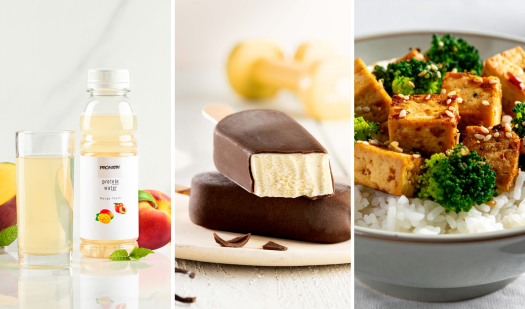
New Asian consumption habits: combining health, pleasure, and convenience
The rise of protein RTD beverages
The RTD format has become the driving force behind pleasure nutrition. These drinks are highly popular with the urban on-the-go population and are no longer used only to quench thirst but to provide immediate functional benefits1.
Vietnam, China and Japan are among the leading markets for sports nutrition in Asia. Japan stands out for its strong culture of convenience and longevity, whereas in China, Gen Y and Gen Z are drawn to flavoured protein products that combine taste with performance[1].
A prime example of this trend is clear protein drinks. Made from whey protein isolates, they offer a high protein content, a light texture, perfect clarity and a refreshing taste.
The rise of healthy functional snacks
Asia is the only region in the world where ‘taste’ and ‘premium’ factors feature in the top five for snacks. Asian consumers refuse to separate pleasure from functionality[1]. While the consumption of protein snacks is on the rise everywhere (Europe, the USA, Asia), the Asian market ranks ‘great taste’ as the absolute number one criterion. An exceptional nutritional profile will never be enough to compensate for a disappointing taste experience.
Manufacturers are responding to this challenge with creative formats, including protein bars, puddings and even high-protein ice creams, using milk proteins.
The rise of flexitarian and vegetarian diets
Faced with declining meat consumption and the rise of flexitarian and vegetarian diets, players in the agri-food sector are stepping up their development of plant-based alternatives to meat products. However, consumers are expressing strong dissatisfaction with these plant-based substitutes, which they find disappointing in terms of both taste and functionality[1]. This frustration presents a direct opportunity for dairy ingredients, which are capable of offering a sensory experience that plant-based alternatives cannot yet match. The future is therefore shaping up to revolve around hybrid matrices: incorporating native dairy proteins into plant-based products helps to address the deficiencies in essential amino acids that could result from a significant shift towards a more plant-based diet.
Lactalis Ingredients’ expertise: high-performance ingredients for the Asian market
Laktein WPC80, whey protein concentrate
Due to its composition, this ingredient is particularly well-suited to the adult nutrition market. A high-protein chocolate concept (29%) has also been developed using our Laktein WPC 80. It is the ideal way to expand your range of functional snacks!

Pronativ®, Native Whey Protein and Micellar Casein
Rich in leucine and branched-chain amino acids (BCAAs), these ingredients effectively stimulate muscle synthesis. Using Pronativ® Micellar Casein, which is characterised by its low viscosity, heat stability and neutral taste, two products have been developed: a high-protein pudding (14% protein in the finished product) and a chocolate-coated ice cream, also high in protein (18% protein in the finished product). A peach and mango-flavoured protein water (17 g of protein per serving) has also been developed using native whey protein.
Flowhey®, high flowability whey powders
Specially designed for the international export market, Flowhey® has low hygroscopicity. It does not clump, even when stored in the hot and humid conditions typical of South-East Asia. The absence of the Maillard reaction ensures neutral taste and colour, making it the ideal choice for gourmet snacks (chocolate, biscuits). It is available in a range of variants to meet specific requirements (Halal, Kosher, Vegetarian) essential for success in these markets.
Conclusion:
In the Asian market, where health and enjoyment are no longer two conflicting demands but a single, shared expectation, dairy ingredients are emerging as the natural solution, with their high nutritional performance, superior sensory profile, and suitability for on-the-go formats. Against the backdrop of the rise of ready-to-drink (RTD) beverages, functional snacks and flexitarian diets, Lactalis Ingredients supports formulators with solutions that never compromise on quality or convenience. This promise is delivered through three key ingredients, Flowhey®, Pronativ® and Laktein, which formulators incorporate into their own innovations to meet the demands of a market that is as equally exacting on taste experience and nutritional value.
A question ? Contact-us !
Sources:
[1] NewFoodData, Baromètre de l’innovation alimentaire mondiale, 2026
[2] Innova Database, 2024. Data 2023-2024
[3] GlobalData, July 2024. Data FY 2023
[4] Euromonitor International, Euromonitor International dévoile les Tendances Mondiales de Consommation pour 2026 – Euromonitor.com, 2025
[5] EDC, Tendances alimentaires en 2026 points essentiels pour les exportateurs, 2026
[6] Innova Market Insights, Global drink trends RTD sports, protein and energy innovation, 2025
[7] Innova Market Insights,Tendances mondiales en matière de snacks, analyses et préférences des consommateurs., 2026
[8] Les 10 tendances alimentaires qui marqueront 2025 selon Innova – Le monde de l’épicerie fine à partir de Synthèse des 10 tendances alimentaires 2025 de Innova Market Insights