 LinkedIn















High-Fluidity Whey Powders and Quality for Sweetened Condensed Creamer Manufacturers
Sweetened Condensed Creamer (SCC) manufacturers face quality challenges that begin long before formulation: sweet whey powder (SWP) stability during transport and storage.
For manufacturers sourcing SWP from international suppliers, logistics stress silently determines whether the ingredient reaches the production line with the colour, flowability, and functional properties required for consistent SCC quality.
Caking, Maillard browning and moisture uptake occur between SWP production and use — during container transport, port storage, and warehouse dwell time. When degraded powder reaches the production line, manufacturers face colour defects, dissolution problems, and batch inconsistency that formulation adjustments cannot solve.
High-fluidity sweet whey powders like Flowhey® are specifically engineered to protect powder integrity through the entire logistics chain, particularly for manufacturers in Asian markets where temperature cycling, humidity exposure, and extended transit times create extreme stress conditions.
Why powder logistics stability is critical for SCC quality?
SCC formulations depend on consistent SWP performance batch after batch. Manufacturers look for powders with specific, repeatable properties: solubility, colour, flowability, and heatstability. That consistency is under threat from the moment the powder leaves the production plant.
Container transport subjects powders to temperature swings of 30°C or more, while atmospheric humidity often rises simultaneously. Coastal port storage exposes them to tropical humidity. Warehouse dwell times extend for weeks. Each stress cycle drives moisture migration, promotes Maillard reactions, and degrades the crystalline structure that determines powder behaviour. The extent of damage depends directly on how well the lactose present in the whey powder has been crystallised before shipment. [1][2]

When powder arrives degraded, manufacturers face cascading problems. Bag emptying becomes difficult as caked powder requires manual breaking and extended discharge time. Dissolution is incomplete, creating lumps and demanding additional mixing. Browning from Maillard reactions forces colour correction attempts that rarely succeed. Batch-to-batch variability increases, driving rework and yield loss.
What defines a high-fluidity whey powder?
High fluidity is not a promotional adjective. It is an emergent property of powder microstructure and composition, engineered for stability under logistics stress.
Controlled lactose crystallisation directly determines powder stability. Two distinct mechanisms are at play here, and both are linked to the degree of crystallisation. First, uncrystallised amorphous lactose is highly hygroscopic: it absorbs moisture readily, which promotes stickiness and caking. Second, amorphous lactose is thermodynamically unstable in the presence of heat and moisture, accelerating the Maillard reaction. Standard whey powders typically reach a crystallisation level of 70–80%. Flowhey® is engineered to achieve approximately 90% crystallisation, significantly reducing both the caking risk and Maillard sensitivity. [1][2]
Particle size distribution matters as well. Excess fines increase interparticle cohesion and dust formation, while overly coarse profiles can promote segregation. The target is a controlled, narrow distribution that balances flow with dissolution behaviour. [1][2]
The Carr Index — a measure of powder compressibility derived from bulk and tapped density — is a reliable predictor of flow behaviour. Powders with lower Carr Index values exhibit better flow characteristics, easier discharge from bags and handling stations, and more consistent dosing. [3][4]
Maillard stability deserves particular attention in SCC applications. The Maillard reaction is a non-enzymatic browning process triggered by the combination of heat, moisture, and the interaction between reducing sugars (such as lactose) and proteins. Under the elevated temperature and humidity conditions typical of hot climates and extended logistics chains, this reaction can accelerate significantly, altering both colour and flavour. The high crystallisation rate of Flowhey® reduces the availability of amorphous lactose that fuels this reaction, providing measurable protection against browning during storage and transport. [2]
Flowhey® is designed with all these parameters in mind, combining controlled lactose crystallisation (around 90%), optimised particle architecture, low Carr Index, and formulation features that support stability under challenging environmental conditions. [3][4][5][6]
Impact on formulation quality: from container to production line
The quality benefits of high-fluidity whey powder begin in the supply chain and extend through production to the finished SCC.
Bag handling remains efficient.
SCC manufacturers typically receive SWP in bags for direct use at powder handling stations. Standard whey powders exposed to logistics stress often arrive partially caked, requiring extended discharge time and manual intervention. While powders such as Flowhey® maintain their original properties, enabling rapid bag emptying and consistent transfer to mixing equipment. [3][4]

Dissolution performance stays consistent.
When SWP is dispersed in water, the crystalline lactose structure is lost. Controlled lactose crystallisation during SCC production, through monitored cooling with seeding lactose, determines final product texture. That process requires powder that dissolves cleanly and leaves no undissolved particles that could disrupt the process.[2][5]
Higher performance and cleaner manipulation.
Powder that flows freely from bags generates less dust, requires less manual intervention, and creates fewer workplace exposure issues. This operational benefit extends from receiving through weighing, mixing, and cleaning operations. [3][4]
Focus on export and Asian markets
For SCC manufacturers operating in Asian markets, logistics constraints amplify every weakness in powder stability.
Container transport involves temperature cycling that standard powders struggle to survive. A container moving from a European port through the Suez Canal to Southeast Asia may experience temperature swings of 30°C or more. Each cycle drives moisture migration within the powder mass, promoting caking and agglomeration, and accelerating Maillard browning. [1][2]
Humidity at destination ports is often extreme. Singapore, Ho Chi Minh City, Mumbai — all present real challenges for hygroscopic materials. Powder that arrives caked or moisture-damaged creates immediate handling problems at the customer’s facility, damaging supplier relationships and generating claims. [1][2]
Extended dwell times are routine. Unlike domestic supply chains where inventory turns quickly, export shipments may sit in warehouses for weeks or months. Powders must maintain their colour, flowability, and dissolution properties across this entire period. [1][2][3][4]
Flowhey® is specifically engineered to withstand these export realities. Its low hygroscopicity and caking resistance, combined with Maillard stability, mean that powder arriving in Bangkok or Jakarta performs the same as powder freshly produced in France — protecting both the supplier’s reputation and the customer’s production quality. [1][2][3][4]
Flowhey® vs standard whey powders: a direct comparison
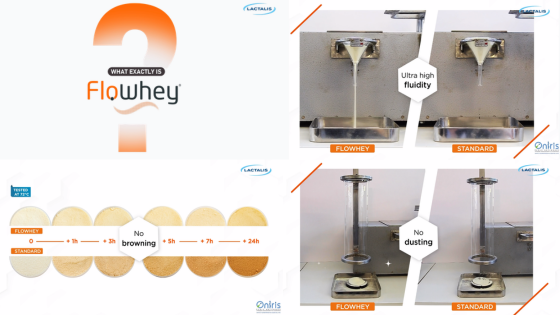
The performance gap between Flowhey® and standard whey powders becomes most apparent under stress conditions.
In controlled warehouse storage, the differences may seem modest. But subject both powders to a realistic export simulation — temperature cycling, humidity exposure, compression under stacking — and the divergence becomes significant across all parameters. [1][2][3][4]
Standard whey powders typically show considerable caking after export simulation, with Carr Index values increasing as the powder compacts and loses its free-flowing character. Bag emptying becomes difficult, and dust generation increases as friable cakes break apart. Maillard browning progresses visibly, creating colour that cannot be corrected in the finished SCC. [1][2][3][4]
Flowhey® maintains its original flow characteristics through the same stress protocol. The Carr Index remains stable, bag handling stays efficient, and the powder reconstitutes cleanly without lumping or extended mixing times. Colour preservation is excellent: powder arriving after months of tropical logistics shows minimal browning compared to fresh production. [3][4][5]
The cost equation is clear. The premium for high-fluidity powder is typically recovered many times over through consistent product quality, reduced colour correction attempts, and — most importantly — avoided customer complaints and claims. [3][4]
Conclusion
High-fluidity whey powders like Flowhey® address this vulnerability at its source: protecting powder through logistics stress, preserving the colour and dissolution properties that formulations depend on, and ensuring that product manufactured for Asian and other export markets meets the same quality standards as product made from fresh powder. [1][2][3][4]
For manufacturers serious about export performance, specifying high-fluidity whey powder is a quality assurance strategy, not a procurement luxury.
FAQ
1- What is the difference between standard whey powder and high-fluidity whey powder?
High-fluidity whey powder is engineered for controlled lactose crystallisation (around 90%, versus 70–80% for standard powders), optimised particle size distribution, and lower Carr Index values. This translates to better flow from bags and handling stations, more accurate dosing, reduced caking during storage and transport, and greater resistance to humidity and temperature cycling. The higher crystallisation rate also protects colour and functional properties through extended logistics chains by limiting the amorphous lactose available to fuel Maillard browning. [1][2][3][4]
2- How does Flowhey® improve powder handling in SCC production?
Flowhey® maintains consistent flowability when emptying bags, enables more accurate weighing and dosing, generates less dust, and resists caking and moisture damage. Manufacturers typically report more consistent dissolution, better colour stability, and more stable batch-to-batch quality. [3][4][5]
3- Does Flowhey® reduce the risk of caking during transport and storage?
Yes. Flowhey®’s controlled lactose crystallisation and low hygroscopicity make it significantly more resistant to caking under the temperature and humidity cycling typical of export logistics. This is particularly important for shipments to tropical and subtropical destinations. [1][2]
4- Is Flowhey® suitable for SCC manufacturers operating in Asian markets?
Flowhey® is specifically designed to withstand the logistics challenges of Asian export markets: extended transit times, high humidity at ports, temperature cycling in containers, and prolonged warehouse storage. Its Maillard stability helps maintain powder colour in hot climates, which in turn enables consistent colour in the finished SCC. [1][2][3][4]
5- How does the Carr Index relate to powder handling performance?
The Carr Index measures powder compressibility and predicts flow behaviour. Lower values indicate better flowability. Flowhey® is manufactured to achieve consistently low Carr Index values, ensuring reliable handling characteristics across production batches even after exposure to logistics stress. [3][4]
A question ? Contact-us !
Sources:
[1] Murrieta-Pazos, I. et al. (2017). “How does particle size influence caking in lactose powder?”. Journal of Food Engineering. https://www.sciencedirect.com/science/article/abs/pii/S0260877417301462
[2] Gaiani, C. et al. (2017). “Physical characterization of whole and skim dried milk powders”. PMC. https://pmc.ncbi.nlm.nih.gov/articles/PMC5629152/
[3] Muñoz-Ibanez, M. et al. (2024). “Factors Influencing Food Powder Flowability”. MDPI Foods. https://www.mdpi.com/2674-0516/3/1/6
[4] Fitzpatrick, J.J. et al. (2000). “Characterisation of food powder flowability”. Journal of Food Engineering. https://www.sciencedirect.com/science/article/abs/pii/S026087749800140X
[5] Kim, S. et al. (2022). “Improved Flowability and Wettability of Whey Protein-Fortified Skim Milk Powder”. https://pubmed.ncbi.nlm.nih.gov/36415577/
[6] Szulc, K. et al. (2023). “Properties and Fractal Analysis of High-Protein Milk Powders”. MDPI Applied Sciences. https://www.mdpi.com/2076-3417/13/6/3573