 LinkedIn

















The cocoa and chocolate crisis: how can dairy ingredients help manufacturers maintain quality and affordability?
Chocolate occupies a unique position within the food industry. As the ultimate indulgence, it remains deeply embedded in global consumer habits, even in difficult economic periods. However, since 2023, the historic surge in cocoa prices has disrupted the economic balance of the entire sector. Although this inflation is now easing, it has left a lasting impact on the industry. In response to rising costs, recipe reformulation has emerged as a strategic lever, with dairy ingredients playing a pivotal role in enabling manufacturers to preserve sensory quality while remaining competitive.
The global chocolate market: a dynamic sector under pressure
A mature market dominated by Europe and marked by seasonal peaks
Chocolate is one of the most widely consumed food products in the world, with Europe the leading global market. In 2024, the French market accounted for 343,000 metric tons of chocolate, equivalent to €3.9 billion. The average annual consumption was 12.3 kg per household, with two major seasonal peaks: Christmas (€744 million) and Easter (€345 million).[1] At a global level, Switzerland stands out as the biggest consumer country, with 9 kg per capita per year, followed by Austria and Germany.[2]
The cocoa crisis: an unprecedented price increase between 2023 and 2024
Cocoa prices almost tripled between 2023 and 2024, rising from an average of approximately $4,200 USD per ton to a peak of around $12,000 USD per ton[3]. This inflation was driven by a sharp decline in cocoa production, which fell by 12.9% between the 2022/2023 and 2023/2024 seasons. This represented a production shortfall of 462,000 tons, the largest recorded in 45 years[4].
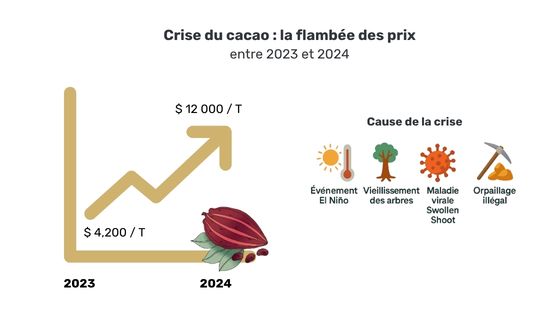
The decline in output can be attributed to a combination of factors: the El Niño weather event, the cacao swollen shoot virus, ageing cocoa trees and illegal gold mining encroaching on farmland – an issue that is particularly significant given that West Africa accounts for approximately 70% of global cocoa production [4].
Direct consequences for manufacturers
Global processing volumes fell by 4.8%, reaching 4.65 million tons for the 2024/2025 season[5]. This had a direct impact on the prices of finished products. For example, Mondelez International raised prices by 5.3% in 2024 while recording a 1% drop in volume. Constraints on purchasing power are prompting consumers to spend more selectively, particularly on products deemed non-essential[6].
In the face of economic downturn, chocolate remains an essential treat
Chocolate: historically resilient during times of crisis
In previous periods of economic downturn, chocolate has proven to be a stable and resilient industry. This is partly due to the importance of this product in consumers’ daily lives. In France, chocolate is enjoyed by 90% of the population and associated with pleasure. In fact, 83% consume it at least once a week[7]. During Easter 2024, despite a 6.5% price increase due to a surge in cocoa prices of over 162% year-on-year, chocolate sales increased by 0.5% in volume and 6.9% in value[8]. Furthermore, more than 24 million additional chocolate bars were sold in 2024 compared to the previous year[9].
Chocolate remains one of the last products consumers are willing to forego, even during periods of financial difficulty. This is because it is strongly associated with pleasure, which is one of the key drivers of purchasing decisions[10].

The challenge for manufacturers: balancing affordability and quality
In the context of rising prices, several strategies can be considered. Manufacturers may opt to reduce product sizes, increase retail prices or adapt recipes. Reformulation is indeed becoming an increasingly relevant solution. Products can be reformulated with reduced cocoa content, as well as with more cost-effective dairy ingredients. For instance, milk powder can be replaced with dairy derivatives such as whey, lactose or whey permeate, at least in part[11]. These cost-effective alternatives also offer valuable functional properties in finished applications.
Consequently, reformulation is emerging as a key strategy for maintaining competitiveness and upholding perceived quality standards. Dairy ingredients are playing a pivotal role in this regard[12]. While they are not a substitute for cocoa, they provide a complementary approach for optimisation, helping to control costs in other areas while maintaining a high-quality finished product.
Dairy products from Lactalis Ingredients: practical levers for reformulation
Flowhey®: a cost-effective alternative to milk powder in chocolate manufacturing
Flowhey® offers an economical alternative to milk powder as a bulking ingredient, owing to its high lactose content. Whey is a skim dairy ingredient composed primarily of lactose (>75%) and protein (minimum 11%), with an ash content comparable to that of milk powder.
Chocolate applications do not typically require as high a protein content as milk, making whey an ideal source of dairy-derived dry matter in chocolate formulations. It is also worth noting that Flowhey® contains a high proportion of crystallised lactose and a relatively low level of amorphous lactose. This significantly limits viscosity build-up during lactose crystallisation in finished products. In addition, it encourages a more consistent and uniform crystallisation of fat within the chocolate matrix. Widely used by chocolate manufacturers across the globe for many years, whey can influence chocolate colour, Maillard reaction development, flavour profile and even viscosity, depending on the desired product characteristics.
In industrial applications, Flowhey® consistently demonstrates excellent flowability. It does not undergo the Maillard reaction and does not cake. A partially demineralised version (40%), Flowhey® D40, is also available. This variant is ideal for formulations requiring a higher proportion of whey solids and a less salty flavour. It therefore offers the same functional characteristics, but with a slightly sweeter taste profile.

Lactose from Lactalis Ingredients: a key ingredient for chocolate texture and crystallisation
Our lactose contributes to a uniform texture and optimal chocolate crystallisation. Its low sweetness offers a distinct advantage in achieving balanced formulations. At Lactalis Ingredients, we have developed a wide range of lactose powders, with purity levels ranging from 99.2% to 99.6%. It is also available in a range of particle sizes, from 40 to 200 mesh, making it easy to adapt to specific processing requirements.
Lactowell® : a high-fluidity whey permeate to optimise cost efficiency and industrial performance
Lactowell® is also an economically alternative to milk powder, whey and lactose. With a lactose content of approximately 80%, it is an effective bulking ingredient. Like Flowhey®, it has excellent flowability, does not undergo the Maillard reaction and is free from caking. These properties enhance its shelf life and improve production line efficiency. In addition, it is highly soluble, facilitating its use in chocolate manufacturing processes.
Conclusion
In the face of an unprecedented cocoa crisis, which is now slowly easing, chocolate manufacturers have been compelled to reconsider formulations to maintain affordability without compromising the taste experience, which is key for consumers. In this context, dairy ingredients represent a particularly relevant lever for reformulation. Whether the objective is to reduce costs, optimise texture or improve chocolate crystallisation, Flowhey®, Flowhey D40, Lactowell® and the lactose range from Lactalis Ingredients provide manufacturers with concrete, proven solutions to address these challenges.
A question ? Contact us !
Sources:
[1] Syndicat du chocolat, Le marché du chocolat en France en 2024, 2024 https://www.syndicatduchocolat.fr/les-chiffres-cles-du-secteur/
[2] Confectionery production, European nations lead upturn on spending for Christmas chocolate confectionery, says latest study, 2023 https://www.confectioneryproduction.com/news/46462/european-nations-lead-upturn-on-spending-for-christmas-chocolate-and-confectionery-says-latest-study/
[3] Confectionery production, ICCO quarterly bulletin reveals projected slump in cocoa production volumes and grindings, 2025 https://www.confectioneryproduction.com/news/52978/icco-quarterly-bulletin-reveals-projected-slump-in-cocoa-production-volumes-and-grindings/
[4] ICCO, Quarterly bulletin of Cocoa statistics, 2024 https://www.icco.org/november-2024-quarterly-bulletin-of-cocoa-statistics/
[5] ICCO, August 2025 Quaterly Bulletin of cocoa Statistics, 2025 https://www.icco.org/august-2025-quarterly-bulletin-of-cocoa-statistics/
[6] Mondelez, Mondelez international reports Q4 and FY 2024 results, 2025 https://ir.mondelezinternational.com/news-releases/news-release-details/mondelez-international-reports-q4-and-fy-2024-results
[7] ConsoGlobe, Planestoscope, Consommation de chocolat en France, 2025 https://www.planetoscope.com/noel-noel-/1011-consommation-de-chocolat-en-france.html
[8] LSA, Pâques 2024 : k=les grands gagnants sont …, 2024https://www.lsa-conso.fr/paques-2024-les-grands-gagnants-sont,455221
[9] NielsenIQ, Grande consommation : comment relancer le marché en 2025, 2025 https://nielseniq.com/global/fr/insights/analysis/2025/grande-consommation-comment-relancer-le-marche-en-2025/
[10] Mintel, The Future of Chocolate, Sugar and Gum Confectionery 2024, 2024 https://store.mintel.com/report/the-future-of-chocolate-sugar-and-gum-confectionery
[11] Food Ingredients 1st, Cocoa prices ease but alternatives and reformulation stay in focus, 2026 https://www.foodingredientsfirst.com/news/cocoa-prices-ease-but-alternatives-and-reformulation-stay-in-focus.html
[12] Confectionary News, The future of chocolate is bittersweet, 2026 https://www.confectionerynews.com/Article/2026/02/10/the-bittersweet-future-of-chocolate-as-cocoa-prices-surge/