 LinkedIn
















Sweetened Condensed Milk and Creamers Market : Trends, Developments, and Formulation Challenges
In a context of mounting pressure on dairy raw material costs, the sweetened condensed milk (SCM) market and its alternatives are currently profound transformation. Historically a well-established product, it is evolving under the influence of new geographic and economic dynamics that are driving manufacturers to rethink their strategies.
Today, manufacturers face a challenge that extends beyond mass production. The goal is to find the perfect equation: balancing cost optimization, adapting to new consumption patterns, while simultaneously ensuring consistent control over the rheological and taste performance of the finished product.
Global Consumption Highly Concentrated and Driven by Emerging Markets
In 2025, global consumption of sweetened condensed milk and creamer reached approximately 2.24 million metric tons. Consumption is concentrated in two major geographic regions: Asia and Latin America, which together account for approximately 85% of global consumption.
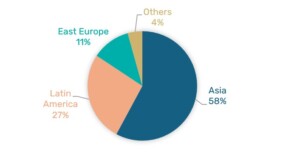 Figure 1 Répartition de la consommation mondiale des LCS & Creamers 2025 (Global Data, 2026)
Although the market shows continuous overall growth, with an average annual growth rate of 1.22% over the decade, this average masks significant disparities.
Not only do Asia and Latin America dominate in terms of volume, but they are also the only genuine real drivers of current growth. Conversely, mature markets (Western Europe and North America), which represent only a marginal share of the market, are experiencing significant consumption decline.
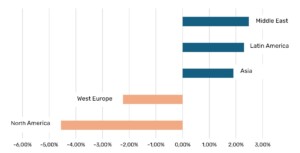
Figure 2 Evolution de la consommation des LCS & creamer par région 2015-2025 (Global Data, 2026)
In these dominant regions, price sensitivity plays a central role in purchasing decisions, both in B2B and B2C contexts. To adapt to this strong economic constraint, manufacturers leverage multiple optimization strategies.
Packaging innovation represents one of the first optimization priorities. There is a gradual transition from traditional metal cans toward the development of flexible formats (stand-up pouches, plastic tubes, cartons). Lighter in weight, these packages significantly reduce export logistics costs while improving price accessibility for local consumers.
The most effective optimization lever remains recipe evolution, particularly through the development of “creamers” (economical substitutes for sweetened condensed milk, formulated using sugar, non-fat milk powders, and vegetable fat). Initially positioned as economical alternatives to traditional sweetened condensed milk, these products are progressively becoming genuine consumption standards in countries such as Indonesia, the Philippines, and Vietnam.
The Technical Challenge of Economic Substitutes
To reduce costs, recipe optimization is at the heart of strategies. Many manufacturers seek to replace expensive ingredients such as milk powder (35% protein) with lower-cost alternatives such as sweet whey powder (11% protein). Some manufacturers go even further by including ingredients such as whey permeate (<3% protein) in their formulations. While highly attractive from a purely financial perspective, permeate presents a major technical and quality challenge: the drastic reduction in protein content in the finished product.
Indeed, milk proteins play an irreplaceable functional role. An excessively significant reduction in their content can result in texture or appearance defects in the product: loss of viscosity (overly liquid product) or stability issues over time (sedimentation or phase separation).
The formulation of recombined sweetened condensed milk is a delicate exercise: each recipe modification can introduce manufacturing defects. Our recent studies on this topic have enabled us to develop a comprehensive set of recommendations, presented in detail in our previous articles:
- The Importance of Protein Concentration for Recombined Sweetened Condensed Milk Formulation
- The Role of Caseins in Sweetened Condensed Milk Formulation
- Adding Stabilizers to Recombined Sweetened Condensed Milk Formulation
Flowhey® Sweet Whey Powder: The Best Technical-Economic Compromise
Used worldwide, sweet whey has become an effective solution for reducing recipe costs while preserving functional properties, where whey permeate quickly shows its limitations.
At Lactalis Ingredients, our expertise enables us to support manufacturers with solutions tailored to their constraints. Flowhey® is a sweet whey powder derived from a two-stage drying process that maximizes the presence of the most stable crystalline form of lactose, namely alpha monohydrate.
Flowhey® exhibits stable physical characteristics thanks to its high content of lactose in alpha monohydrate form. This specificity limits caking and compacting phenomena generally observed when powders are exposed to high temperature and humid conditions – constraints that are particularly common in the major SCM and creamers production regions, notably in Asia, Latin America, the Middle East, and Africa.
Used in SCM or creamers formulations, Flowhey® also-helps maintain smooth texture over time while preserving the color of the finished product.
Discover concretely how to optimize your recipes with our dedicated article: Flowhey® in Sweetened Condensed Milk.
Conclusion
The global sweetened condensed milk and creamer market demands simultaneous mastery of technical performance and cost optimization. Given this competitive reality, relying on trustworthy dairy ingredients – such as Flowhey® sweet whey powder – and on the technological expertise of a global partner like Lactalis Ingredients becomes a key strategy for balancing these two imperatives sustaining margins and securing international market share.
A question ? Contact-us !
Sources:
- GlobalData. Dairy & soy food market data – Historique et prévisions de la consommation mondiale et régionale des laits concentrés sucrés (LCS) et creamers (2015-2030).
- Lactalis Ingredients. (2024). Ajout de texturants dans la formulation des laits concentrés sucrés recombinés. https://www.lactalisingredients.com/fr/news/blog/ajout-de-texturants-dans-la-formulation-des-laits-concentres-sucres-recombines/
- Lactalis Ingredients. (2021). Flowhey® dans les laits concentrés sucrés. https://www.lactalisingredients.com/fr/news/blog/flowhey-dans-les-laits-condenses-sucres/
- Lactalis Ingredients. (2023). Importance des caséines dans la formulation du lait condensé sucré. https://www.lactalisingredients.com/fr/news/blog/importance-des-caseines-dans-la-formulation-du-lait-condense-sucre/
- Lactalis Ingredients. (2024). L’importance de la concentration en protéines pour la formulation de laits concentrés sucrés recombinés. https://www.lactalisingredients.com/fr/news/blog/importance-de-la-concentration-en-proteines-pour-la-formulation-de-laits-concentres-sucres-recombines/
- Mintel GNPD. Analyse des lancements mondiaux des LCS et creamers & évolution des formulations (utilisation du lactosérum, perméat ou maltodextrine).